What is the Bala Mukunda Ashtakam and who composed it?
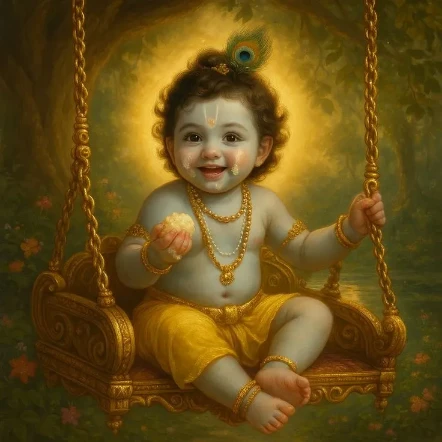
The Bala Mukunda Ashtakam is a beautiful devotional hymn dedicated to Lord Krishna in his divine child form, Bala Mukunda. The stotra contains eight verses (ashtakam) describing the enchanting childhood leelas of Krishna, such as lying on a banyan leaf during cosmic dissolution, stealing butter in Vrindavan, dancing on the serpent Kaliya, and being lovingly cared for by Mother Yashoda. Composed by the great philosopher-saint Adi Shankaracharya, who also wrote many devotional stotras praising different forms of Lord Vishnu and Krishna. Bala Mukunda refers to the infant form of Krishna who is worshipped as the supreme Lord appearing in a playful and innocent child form.
What is the meaning and symbolism of Bala Mukunda Ashtakam?
The Bala Mukunda Ashtakam describes the divine beauty and playful childhood lilas (pastimes) of Lord Krishna while revealing deep spiritual symbolism. The first verse visualizes baby Krishna lying on a banyan leaf during the cosmic dissolution (pralaya), representing the eternal nature of the Supreme Being beyond creation and destruction. Other verses describe his butter-stealing pastime, his dance on the serpent Kaliya in the Yamuna river, and his childhood mischief in Vrindavan. Through these images, the hymn teaches that the infinite Lord Vishnu appears as a charming child to bless devotees with love, devotion, and spiritual realization.
What are the benefits of chanting Bala Mukunda Ashtakam?
Chanting Bala Mukunda Ashtakam with devotion is believed to bring peace, happiness, and divine protection. Devotees recite this Krishna stotra to develop loving devotion (bhakti), remove stress and negativity, and invite the blessings of Lord Krishna in their lives. The hymn is also associated with blessings for children, family harmony, and emotional healing because it meditates on the innocent and compassionate child form of Krishna. Regular recitation helps devotees cultivate purity of heart, joy, and spiritual connection with Lord Vishnu.
When is the best time to chant Bala Mukunda Ashtakam?
The Bala Mukunda Ashtakam can be chanted daily during morning prayers, meditation, or Krishna worship. Many devotees recite it during Krishna-related festivals such as Janmashtami, Gokulashtami, and other Vaishnava celebrations. Chanting this stotra while meditating on baby Krishna in Vrindavan or offering prayers before a Bala Krishna idol is considered especially auspicious and spiritually uplifting.
Why is Lord Krishna worshipped as Bala Mukunda in this stotra?
In this stotra, Lord Krishna is worshipped as Bala Mukunda, the divine child who embodies innocence, joy, and unconditional love. The child form of Krishna represents the Supreme Lord in his most accessible and loving aspect, allowing devotees to connect with him through affection and devotion rather than fear or formality. By meditating on Bala Mukunda—Krishna lying on a banyan leaf, playing in Vrindavan, or drinking milk from Mother Yashoda—devotees experience a deep sense of spiritual intimacy and divine grace.
What is the significance of the banyan leaf (Vatapatra) image in Bala Mukunda Ashtakam?
One of the most famous images in the Bala Mukunda Ashtakam is baby Krishna lying on a banyan leaf (Vatapatra) during the cosmic dissolution. This symbolic form, known as Vatapatra Shayi Vishnu, represents the Supreme Being who remains present even when the entire universe dissolves. The tiny child floating on a leaf illustrates that the infinite divine power can appear in the simplest and most charming form, reminding devotees that the eternal Lord sustains creation with effortless grace.